
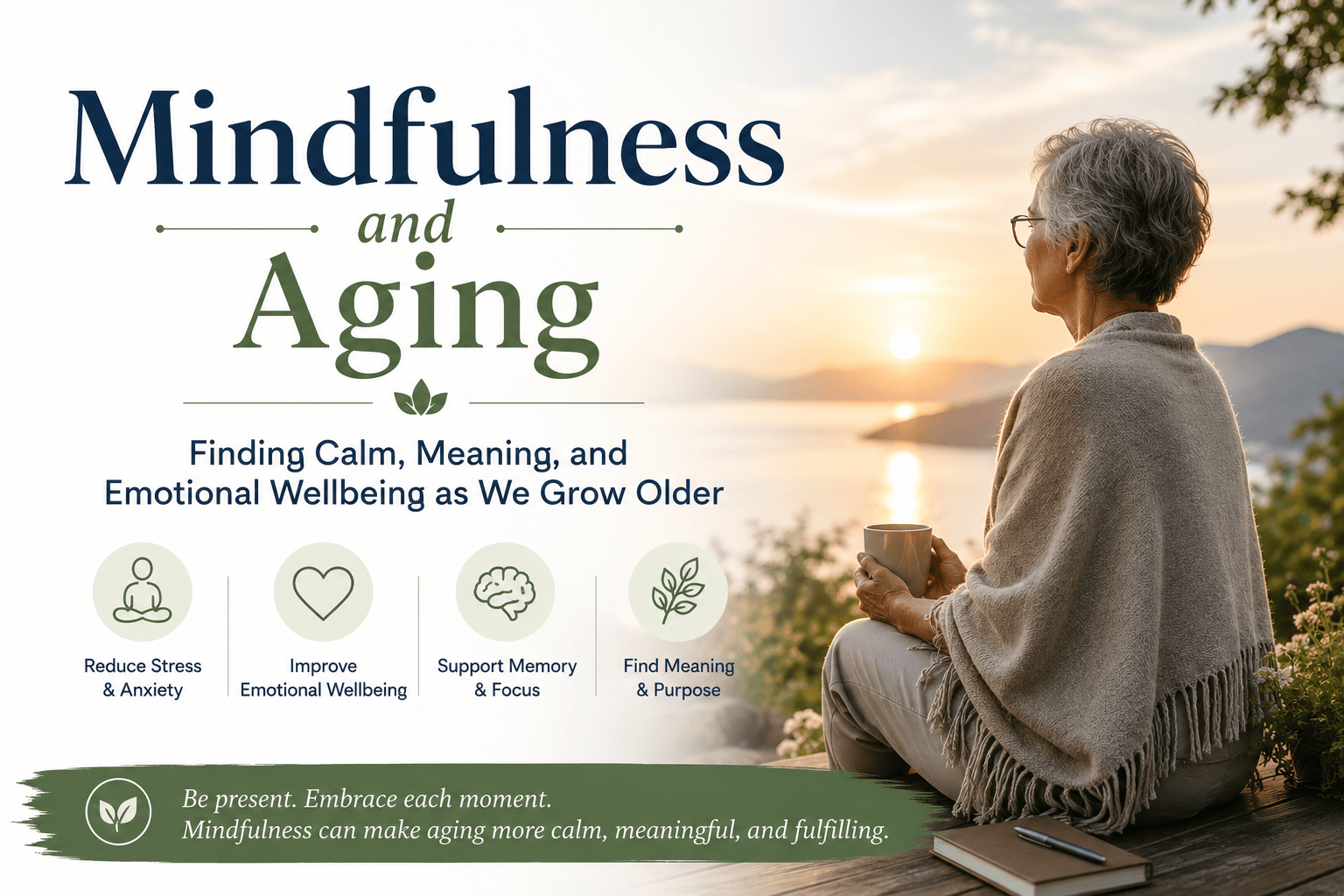
Aging is a natural part of life.
Yet it can also bring changes that are sometimes difficult to navigate.
You may notice changes in your energy levels, sleep patterns, memory, physical health, relationships, or daily routines. You may be adjusting to retirement, caring for loved ones, coping with chronic health conditions, or grieving losses that come with different stages of life.
Many people also carry worries such as:
- “Am I becoming less independent?”
- “Why don’t I feel like myself anymore?”
- “Will my health continue to decline?”
- “How do I cope with all these changes?”
These concerns are understandable.
Aging is not only a physical process—it is also an emotional one.
Researchers have increasingly become interested in whether mindfulness and meditation may help support emotional wellbeing, resilience, and quality of life as people age.
It is important to say this clearly:
Mindfulness is not a way to stop aging or prevent all age-related changes.
However, research suggests that mindfulness practices may help some people cope with stress, improve emotional wellbeing, and cultivate greater acceptance and self-compassion during later stages of life.
What Does Healthy Aging Mean?
Healthy aging is about much more than avoiding illness.
According to the World Health Organization, healthy aging involves maintaining functional ability and wellbeing throughout life.
This may include:
- Physical health
- Emotional wellbeing
- Social connection
- Cognitive functioning
- Sense of purpose and meaning
Aging looks different for everyone.
Some individuals remain physically active and socially engaged, while others may face chronic illnesses, caregiving responsibilities, or significant life changes.
There is no single “right way” to age.
The Emotional Side of Aging
Growing older can bring many emotional experiences.
These may include:
- Grief after losing loved ones
- Concerns about health
- Loneliness
- Changes in identity after retirement
- Fear of dependency
- Worries about memory or cognitive changes
At the same time, many people also experience:
- Greater wisdom
- Increased perspective
- Deeper appreciation for relationships
- Stronger emotional resilience
Aging often brings both challenges and opportunities.
Stress and Aging
Chronic stress can affect wellbeing at any age.
As people grow older, stressors may include:
- Health concerns
- Financial worries
- Caregiving responsibilities
- Loss and bereavement
- Changes in social roles
Long-term stress may influence:
- Sleep quality
- Emotional wellbeing
- Physical health
- Quality of life
This is one reason researchers have become interested in mindfulness-based interventions for older adults.
What Is Mindfulness?
Mindfulness involves paying attention to the present moment with openness and curiosity.
It means noticing thoughts, emotions, and bodily sensations without immediately judging them.
Mindfulness is not about pretending aging is easy.
It does not ask us to ignore grief, uncertainty, or physical limitations.
Instead, it encourages a gentler relationship with difficult experiences.
For example, instead of automatically thinking:
“Everything is getting worse.”
Mindfulness may invite:
“I notice sadness and fear are present right now.”
This small shift may reduce emotional suffering.
Can Mindfulness Help As We Age?
Research in this area is promising.
Several studies suggest that mindfulness-based interventions may improve:
- Emotional wellbeing
- Perceived stress
- Anxiety symptoms
- Depressive symptoms
- Sleep quality
- Quality of life
Some studies have also explored possible relationships between mindfulness and cognitive health, although findings remain mixed and more research is needed.
At present, there is insufficient evidence to conclude that meditation can prevent dementia or stop age-related cognitive decline.
Claims such as:
“Meditation keeps the brain young forever.”
are not supported by current scientific evidence.
A more accurate statement would be:
Mindfulness may support emotional wellbeing and certain aspects of healthy aging, but it is not a cure for age-related conditions.
Mindfulness and Emotional Resilience
One of the most valuable aspects of mindfulness may be emotional resilience.
Aging often involves learning to live with uncertainty.
Mindfulness may help people:
- Become less overwhelmed by difficult emotions
- Respond more gently to change
- Develop greater acceptance
- Cultivate self-compassion
Acceptance does not mean giving up.
Rather, it means acknowledging reality while continuing to care for ourselves.
Mindfulness and Loneliness
Loneliness can become more common with age due to:
- Retirement
- Bereavement
- Health limitations
- Changes in social networks
Loneliness can affect both emotional and physical wellbeing.
Mindfulness cannot replace human connection.
However, some individuals find that mindfulness helps them become more aware of their emotional needs and encourages greater self-kindness during periods of isolation.
Mindfulness and Grief
Many people experience losses as they age.
These losses may include:
- Loved ones
- Physical abilities
- Roles and identities
- Familiar routines
Grief deserves compassion.
Mindfulness does not remove grief.
Rather, it encourages us to make space for it.
Some days, mindfulness may simply mean acknowledging:
This hurts.
That acknowledgment itself can be healing.
Mindfulness and Sleep
Sleep often changes with age.
Many older adults experience:
- Difficulty falling asleep
- Frequent awakenings
- Changes in sleep patterns
Research suggests that mindfulness practices may improve sleep quality for some individuals.
Better sleep may support overall wellbeing.
Mindfulness and Cognitive Health
Researchers have explored whether mindfulness might support attention, memory, and cognitive functioning.
Some studies suggest potential benefits in areas such as:
- Attention
- Emotional regulation
- Perceived cognitive functioning
However, findings remain preliminary.
More research is needed before strong conclusions can be made.
Mindfulness should not be viewed as a treatment for cognitive disorders.
A Gentle Mindfulness Practice
Three-Minute Breathing Exercise
Sit comfortably.
Notice your breathing.
There is no need to change it.
Simply observe:
- The sensation of breathing in
- The rise and fall of the chest
- The feeling of exhaling
If thoughts arise, gently return attention to the breath.
The goal is not to stop thinking.
The goal is simply awareness.
Gratitude Practice
Each evening, gently reflect on:
- One person you appreciate
- One moment of comfort today
- One thing your body allowed you to do
Gratitude does not mean ignoring difficulties.
It simply allows space for both challenges and moments of goodness.
Self-Compassion Practice
Place a hand on your chest and silently repeat:
Aging can be difficult.
I am doing the best I can.
May I respond to myself with kindness.
When Mindfulness May Feel Difficult
Mindfulness can sometimes bring awareness to difficult emotions.
You may notice:
- Sadness
- Fear
- Loneliness
- Grief
- Frustration
This is normal.
You do not need to force yourself.
Even one mindful breath can be enough.
When to Seek Additional Support
Please consider seeking professional support if you experience:
- Persistent low mood
- Significant anxiety
- Severe loneliness
- Memory concerns affecting daily functioning
- Sleep problems affecting quality of life
Mindfulness is only one piece of overall wellbeing.
Additional support can be valuable.
A Gentle Daily Routine
Morning:
Three minutes of mindful breathing.
Afternoon:
A mindful walk or spending time in nature.
Evening:
A short gratitude or self-compassion practice.
Consistency matters more than perfection.
Final Thoughts
Aging brings both challenges and opportunities.
It may involve changes in health, relationships, roles, and identity.
Mindfulness does not promise to stop aging.
What it may offer instead is:
- Greater emotional resilience
- More self-compassion
- Increased appreciation of the present moment
- A gentler relationship with change
You do not need to navigate aging perfectly.
Some days may feel easier than others.
On difficult days, mindfulness may simply mean pausing, taking a breath, and reminding yourself:
I deserve kindness in every stage of life.
That, too, is meaningful.
Medical Disclaimer
This article is for educational purposes only and should not be considered medical advice. Mindfulness and meditation are complementary practices and should not replace professional medical care, diagnosis, or treatment.
References
- World Health Organization. Healthy Ageing and Functional Ability. World Health Organization. 2020.
- Geiger PJ, Boggero IA, Brake CA, et al. Mindfulness-Based Interventions for Older Adults: A Review of the Effects on Physical and Emotional Wellbeing. Mindfulness. 2016.
- Lenze EJ, Hickman S, Hershey T, et al. Mindfulness-Based Stress Reduction for Older Adults With Worry Symptoms and Co-Occurring Cognitive Dysfunction. International Journal of Geriatric Psychiatry. 2014.
- Gard T, Hölzel BK, Lazar SW. The Potential Effects of Meditation on Age-Related Cognitive Decline: A Systematic Review. Annals of the New York Academy of Sciences. 2014.
- Creswell JD. Mindfulness Interventions. Annual Review of Psychology. 2017.
- Black DS, O’Reilly GA, Olmstead R, Breen EC, Irwin MR. Mindfulness Meditation and Improvement in Sleep Quality and Daytime Impairment Among Older Adults With Sleep Disturbances. JAMA Internal Medicine. 2015.
- Wolkin JR. Cultivating Multiple Aspects of Attention Through Mindfulness Meditation Accounts for Psychological Well-Being Through Decreased Rumination. Psychology Research and Behavior Management. 2015.
Leave a Reply