
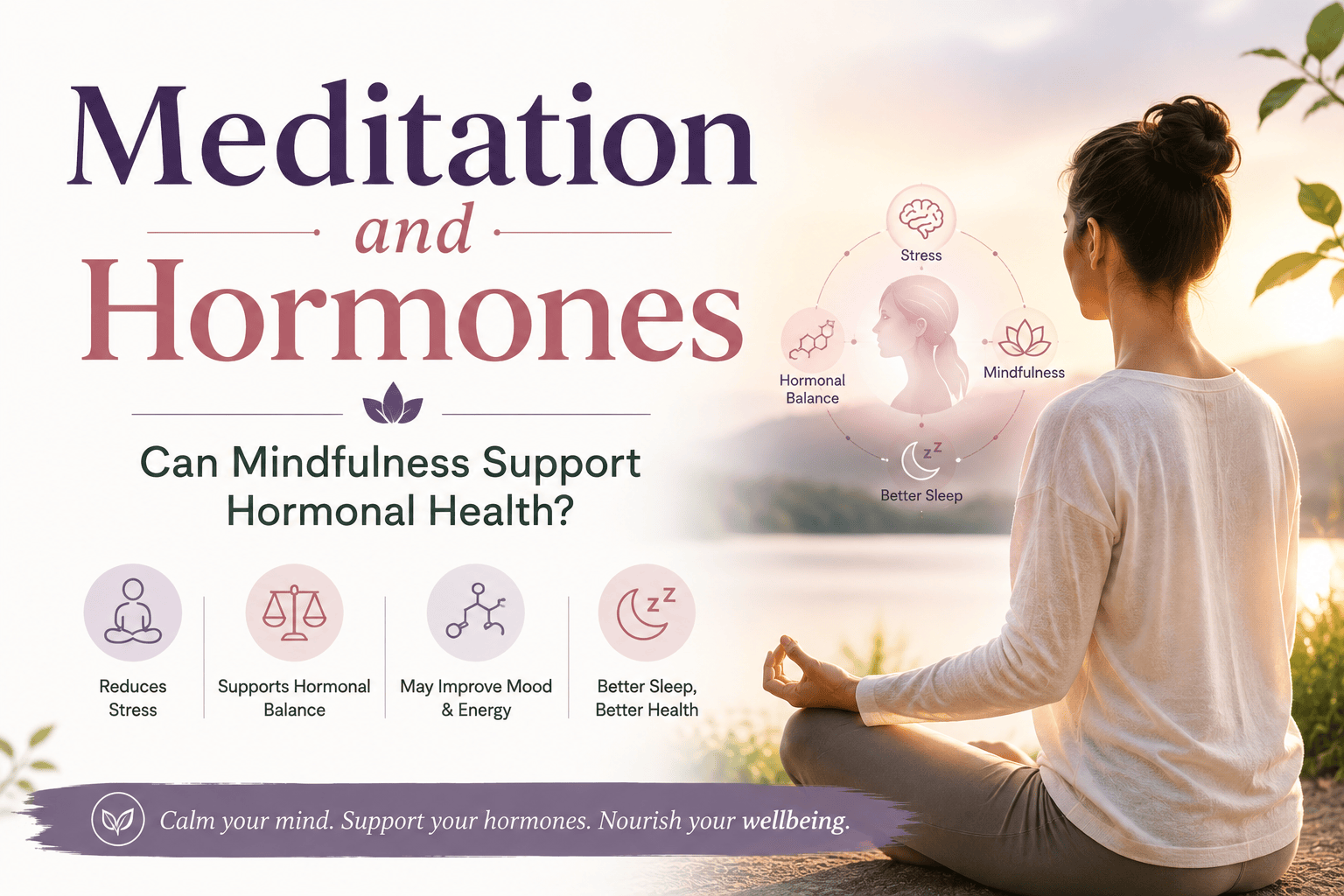
Hormones influence nearly every aspect of our wellbeing.
They affect energy levels, mood, sleep, appetite, metabolism, menstrual cycles, fertility, and even how we respond to stress.
When hormones feel “out of balance,” many people notice symptoms such as:
- Mood swings
- Fatigue
- Anxiety
- Sleep difficulties
- Increased cravings
- Changes in weight
- Irregular periods
- Brain fog
- Feeling unlike themselves
These experiences can be frustrating and, at times, emotionally overwhelming.
You may find yourself wondering:
- Is stress making my symptoms worse?
- Can meditation help with hormonal health?
- Why do I feel so different during certain phases of my cycle?
These are understandable questions.
Researchers have become increasingly interested in the relationship between stress, the nervous system, and hormonal functioning.
However, it is important to state this clearly:
Meditation is not a treatment for hormonal disorders and should never replace medical evaluation or treatment.
Conditions such as PCOS, thyroid disorders, endometriosis, menopause-related symptoms, and PMDD often require appropriate medical care.
That said, mindfulness and meditation may help some individuals better cope with the emotional and physical challenges associated with hormonal changes.
What Are Hormones?
Hormones are chemical messengers produced by various glands in the body.
They help regulate many important functions, including:
- Menstrual cycles
- Metabolism
- Blood sugar regulation
- Stress responses
- Sleep and circadian rhythms
- Reproductive health
- Mood and emotions
Some important hormones include:
- Estrogen
- Progesterone
- Cortisol
- Insulin
- Thyroid hormones
- Testosterone
- Melatonin
Hormonal systems are complex and interconnected.
A change in one system may influence others.
Hormones and Emotional Wellbeing
Many people notice emotional changes during hormonal shifts.
Examples include:
- Increased anxiety before menstruation
- Mood changes during perimenopause
- Irritability during periods of sleep deprivation
- Emotional symptoms associated with thyroid disorders
- Stress-related changes in menstrual cycles
These experiences are real.
Hormonal fluctuations can significantly affect emotional wellbeing.
This does not mean symptoms are “all in your head.”
Understanding the Stress-Hormone Connection
One of the most studied hormones in relation to mindfulness is cortisol.
Cortisol is often called the “stress hormone.”
When we experience stress, the body activates the hypothalamic-pituitary-adrenal (HPA) axis, leading to increased cortisol production.
Short-term increases in cortisol are normal.
The concern arises when stress becomes chronic.
Periods of prolonged stress may influence:
- Sleep quality
- Appetite
- Menstrual cycles
- Energy levels
- Emotional wellbeing
- Blood sugar regulation
Many individuals become trapped in a cycle such as:
Stress → Poor sleep → Increased symptoms → More stress
This cycle can become exhausting.
What Is Mindfulness?
Mindfulness involves paying attention to the present moment with openness and curiosity.
It means noticing thoughts, emotions, and physical sensations without immediately judging them.
Mindfulness is not about pretending symptoms do not exist.
Instead, it encourages a gentler relationship with difficult experiences.
For example, instead of automatically thinking:
“My body is broken.”
Mindfulness may invite:
“I notice frustration, fatigue, and sadness are present right now.”
This small shift may reduce emotional suffering.
Can Meditation Affect Hormones?
This is where the evidence becomes nuanced.
Current research suggests that mindfulness and meditation may influence certain stress-related physiological pathways.
Some studies have reported changes in:
- Cortisol levels
- Stress reactivity
- Sleep quality
- Emotional wellbeing
However, there is currently insufficient evidence to conclude that meditation can directly “balance hormones” or treat hormonal disorders.
Claims such as:
“Meditation fixes hormones.”
or
“Meditation cures PCOS.”
are not supported by current scientific evidence.
A more accurate statement would be:
Meditation may help reduce stress and improve emotional wellbeing, which may indirectly support overall hormonal health.
Meditation and Cortisol
Among all hormones, cortisol has been most extensively studied in mindfulness research.
Several studies suggest that mindfulness interventions may reduce perceived stress and may influence cortisol regulation in some individuals.
However, findings are mixed.
Not all studies show significant changes, and more high-quality research is needed.
Meditation and Menstrual Health
Stress can influence menstrual functioning in some individuals.
Periods of significant emotional stress have been associated with:
- Changes in cycle regularity
- Worsening PMS symptoms
- Increased emotional distress
Mindfulness may help some individuals cope with:
- Premenstrual symptoms
- PMDD-related stress
- Anxiety around hormonal changes
- Emotional fluctuations during the menstrual cycle
Importantly, mindfulness should be viewed as a supportive practice rather than a primary treatment.
Meditation and Menopause
Hormonal changes during perimenopause and menopause can bring symptoms such as:
- Hot flashes
- Sleep difficulties
- Mood changes
- Anxiety
- Fatigue
Some studies suggest that mindfulness interventions may improve quality of life and emotional wellbeing during menopause.
However, evidence remains evolving.
Meditation and PCOS
Many individuals living with PCOS experience:
- Stress
- Body image concerns
- Weight-related stigma
- Anxiety or depression symptoms
Mindfulness may help support:
- Emotional wellbeing
- Self-compassion
- Stress management
- Relationship with food and body image
Again, mindfulness is not a treatment for PCOS itself.
How Might Mindfulness Help?
1. Reducing Stress Reactivity
Mindfulness may help individuals become less emotionally reactive to stress.
This may indirectly support overall wellbeing.
2. Improving Sleep
Sleep and hormonal health are closely connected.
Mindfulness practices may improve sleep quality in some individuals.
3. Supporting Emotional Regulation
Hormonal fluctuations can be emotionally challenging.
Mindfulness may help create space for difficult emotions without immediately becoming overwhelmed by them.
4. Increasing Self-Compassion
Many people become frustrated with their bodies.
Common thoughts include:
- “Why can’t my body function normally?”
- “I should be handling this better.”
Mindfulness encourages greater kindness toward ourselves.
A Gentle Mindfulness Practice
Three-Minute Breathing Exercise
Sit comfortably.
Notice your breathing.
There is no need to change it.
Simply observe:
- Air entering and leaving the body
- The rise and fall of your chest
- The sensation of exhaling
If thoughts arise, gently return your attention to the breath.
The goal is not to stop thinking.
The goal is simply awareness.
Self-Compassion Practice
Place a hand on your chest and silently repeat:
My body has been carrying a lot.
This is difficult.
May I respond to myself with kindness today.
When Mindfulness May Feel Difficult
Mindfulness can sometimes bring awareness to painful emotions.
You may notice:
- Grief
- Frustration
- Anger
- Fear about your health
This is normal.
You do not need to force yourself.
Even one mindful breath can be enough.
When to Seek Medical Evaluation
Please seek medical assessment if you experience symptoms such as:
- Significant menstrual changes
- Persistent fatigue
- New hair loss
- Unexplained weight changes
- Severe mood symptoms
- Symptoms affecting daily functioning
Hormonal symptoms deserve proper medical evaluation.
A Gentle Daily Routine
Morning:
Three minutes of mindful breathing.
Afternoon:
A short mindful walk.
Evening:
Five minutes of gratitude or self-compassion practice.
Consistency matters more than perfection.
Final Thoughts
Hormonal changes can affect much more than the body.
They can influence emotions, relationships, confidence, and quality of life.
Mindfulness does not promise perfectly balanced hormones.
What it may offer instead is:
- Greater emotional resilience
- Reduced stress
- More self-compassion
- A gentler relationship with your body
You do not need to feel positive all the time.
You do not need to handle everything perfectly.
Sometimes healing begins with something much smaller:
Pausing.
Taking a breath.
And reminding yourself:
My body is doing its best, and I deserve kindness while navigating this journey.
That, too, is meaningful.
Medical Disclaimer
This article is for educational purposes only and should not be considered medical advice. Meditation and mindfulness are complementary practices and should not replace professional medical care, diagnosis, or treatment.
References
- Pascoe MC, Thompson DR, Jenkins ZM, Ski CF. Mindfulness mediates the physiological markers of stress: Systematic review and meta-analysis. Journal of Psychiatric Research. 2017.
- O’Connor DB, Thayer JF, Vedhara K. Stress and Health: A Review of Psychobiological Processes. Annual Review of Psychology. 2021.
- Black DS, Slavich GM. Mindfulness meditation and the immune system: A systematic review of randomized controlled trials. Annals of the New York Academy of Sciences. 2016.
- Carlson LE, Speca M, Patel KD, Goodey E. Mindfulness-Based Stress Reduction in Relation to Quality of Life, Mood, Symptoms of Stress, and Cortisol Levels. Psychoneuroendocrinology. 2004.
- Green SM, Key BL, McCabe RE. Cognitive-Behavioral, Behavioral, and Mindfulness-Based Therapies for Menopausal Symptoms: A Review. Maturitas. 2015.
- Teede HJ, Misso ML, Costello MF, et al. Recommendations From the International Evidence-Based Guideline for the Assessment and Management of Polycystic Ovary Syndrome. Human Reproduction. 2018.
- Rapkin AJ, Lewis EI. Treatment of Premenstrual Dysphoric Disorder. Women’s Health. 2013.
Leave a Reply